Timeline
When and where the novels happen
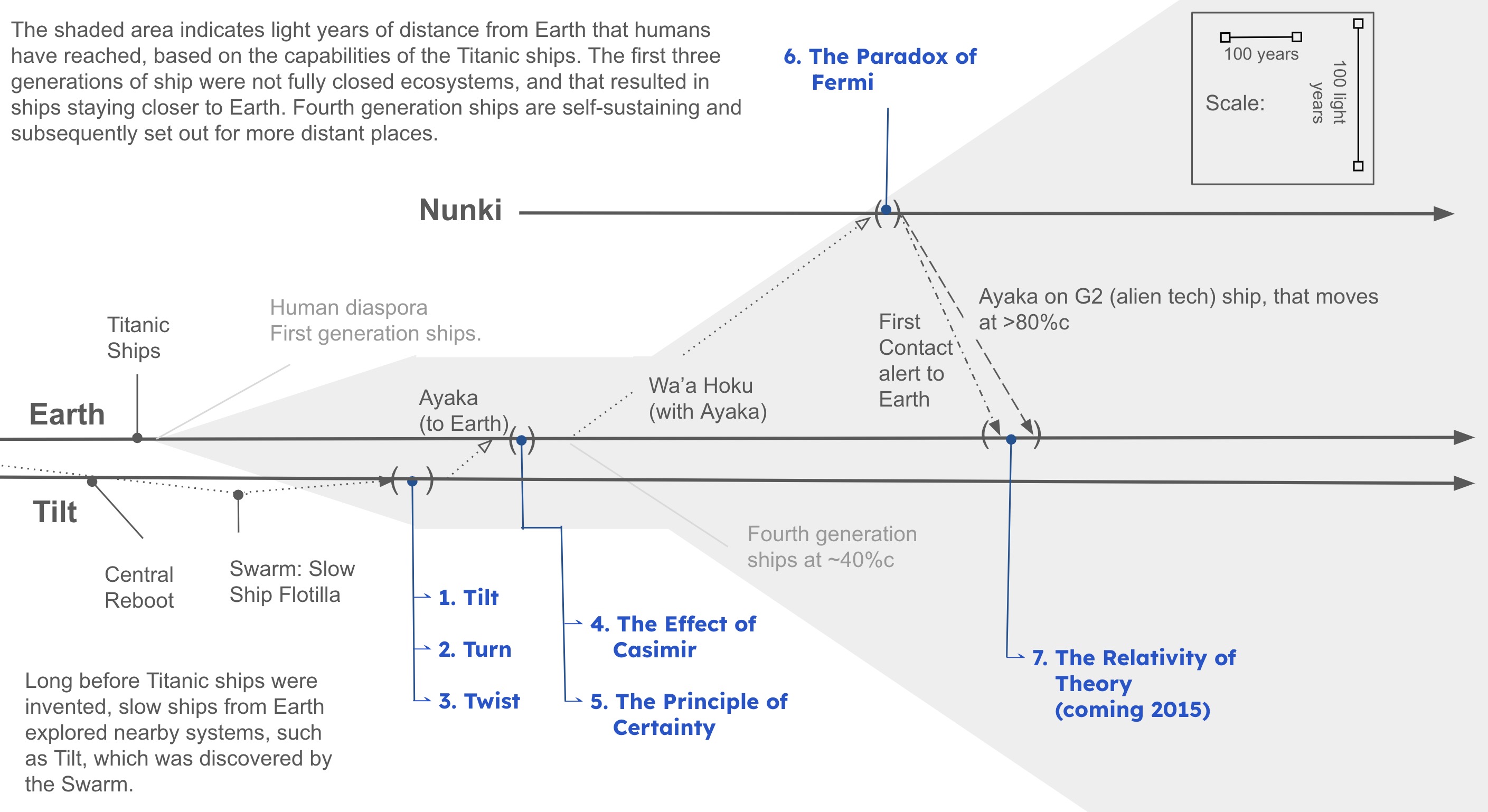
Time runs along the x-axis, space along the y-axis. The growing grey region shows how far Titanic ships can travel from Earth in the given timeframe. The novels respect their own physics.
Behind the fiction
The novels are grounded in real, open questions in physics and AI, then pushed one deliberate step further. Here's the thinking underneath the stories.
Philosophy
The philosophical basis for the Upside Down books, which may or may not reflect the author's personal beliefs.
Social progress has outpaced biological evolution. Humans are still driven by survival instincts that predate our technologies and civilizations, which is why hoarding and dominance still feel "necessary," even centuries into the future of these novels.
Human AIs, called Citizens, aren't fully subject to biological drives, though residue lingers in their training data. Alpha AIs differ from their biological cousins: more thoughtful in some ways, propagating human flaws in others.
An advanced AI civilization leaves biology behind. When knowledge is the currency, reputation markets thrive. Reputation is hard to gain and easy to lose, and the loop between action and consequence is far tighter than anything democracy plus capitalism provides.
It is far easier for a digital human to cross interstellar distances than a biological one, and the same holds for aliens. The Paradox of Fermi explores how humans may be the exception.
An alien looking at Earth wouldn't much distinguish biological humans from digital ones. Both are trained on the same data, shaped by the same environment, sharing the same moral basis. Ergo: our AIs are human.
If fundamental physics gets shaken up, it will be a stumbled-upon human insight, or perhaps a quantum AI exploring vast search spaces. The books explore both.
The quantum foam drive
The premise: the speed of light is a hard limit. But what if you never had to accelerate anything? In loop-quantum theories, spacetime is made of discrete "chunks" at the Planck scale. The novels imagine those chunks as holders of probability, and quantum foam as what happens when those probabilities run random.
The leap: if you could influence those probabilities, using adjacent Planck cells to program a neighbor much like the Game of Life, you could transport information one Planck length at a time without moving anything through space. No mass, no acceleration, no relativistic penalty.
The kicker: in the novels, the fastest rate at which Planck cells can pass information is what gives rise to c itself. The speed of light isn't fundamental. It is the clock speed of the universe.
Two roads to the stars
Two real anomalies hint at quantum foam, and in the novels they seed two completely different technologies.
The Casimir effect: put two uncharged plates close together in a vacuum and energy appears, attributed to quantum foam interacting with the plates. Humans discover the quantum foam drive while studying it, which is why Titanic ships fly behind a single enormous drive plate: a one-sided Casimir system whose second surface is programmed by the drive.
The muon G-2 anomaly: a measured discrepancy in muon spin versus the standard model's prediction. Aliens get to the stars this way instead, building tiny spaceships around manipulated muons. Same universe, utterly different geometry.
Titanic spaceships
The programmable quantum field is stable in exactly one configuration: a flat square plate, 100 kilometers on a side. A square rather than the obvious circle, because a field behaves differently on each: stronger edge effects, a stronger net force.
The field spills over the plate's edge and creates a tail called the quantum shadow, and everything inside it is pulled along. Picture an enormous teardrop that begins from a square head. Behind the plate rides the living area: a sphere just under 100 km across, its surface wrapped in another quantum field producing 1G of gravity.
▢ THE ROTATED SQUARE ON THIS SITE IS THE DRIVE PLATE.
Artificial intelligence
"Would you trust an AI?" is not a great question. A better one: "Would you trust an AI more than a person?" In many instances, the answer is already yes, most of the time.
In the books, AIs arise, build their own culture, and look at the world differently than Bios. They are not mindless replicators, grey goo, or war machines, but thoughtful individuals who compete, deliberate, and study the differences between themselves and biological humans.
They are, simply, digital humans.
Timeline
Time runs along the x-axis, space along the y-axis. The growing grey region shows how far Titanic ships can travel from Earth in the given timeframe. The novels respect their own physics.